

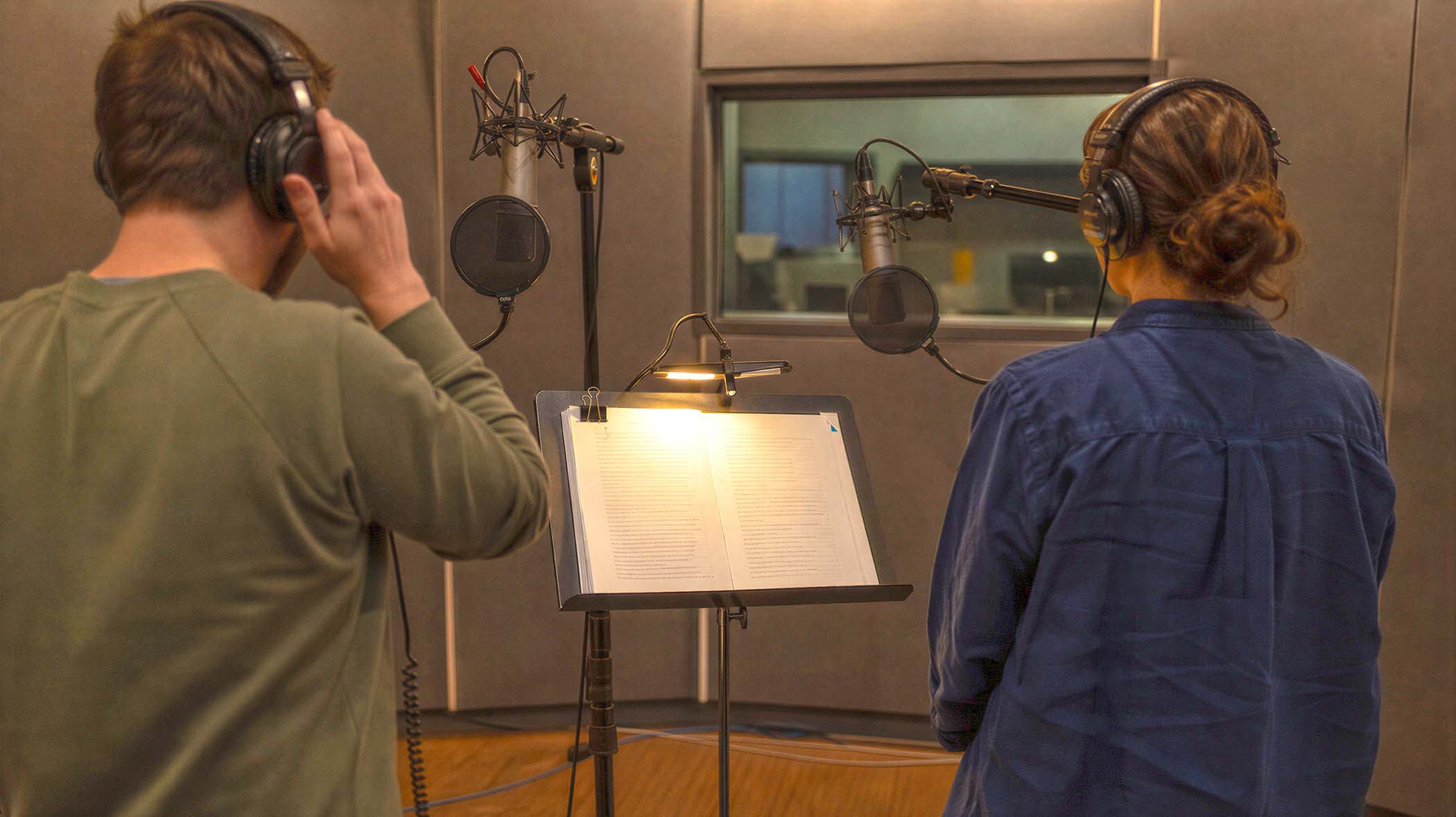
In a full cast audiobook session, the longest discussion of the day is rarely about interpretation. It is about the exact point where one voice hands over to the other. Two performers read the same passage four times just to line up their breathing on the handover. Nobody will ever notice it, and everybody notices when it is missing.
The choice between one narrator and a cast depends on how the book is built, not on how ambitious the project feels. A full cast audiobook earns back its budget when the text alternates between distinct narrative viewpoints and when the title sits in an ensemble genre. Outside those conditions, a single narrator with strong direction delivers more for the same money.
Which Genres Justify a Full Cast Audiobook
The test is not length, it is narrative structure. Novels that alternate first person chapters between several characters already have the voice changes written into them. The same holds for epistolary texts and for non-fiction built on interviews, where a different timbre per source gives the listener the orientation typography provides on the page.
Consumption data points to where the demand sits. The Audio Publishers Association reports that general fiction took the largest share of audiobook revenue in 2025 at 27 percent, with science fiction and fantasy, romance and thrillers completing the leading genres. Those are the catalogues with recurring characters and heavy dialogue, where telling the voices apart actually does something.
Then there is the opposite case, discussed far less. A memoir or a novel with a strong narrating voice gains nothing from a cast. It gains from closer direction on that one voice, as in the recording of the audiobook with Antonio Albanese.
What Changes in Direction When There Is More Than One Voice
Costs do not rise on one front alone. Studio hours multiply by the number of performers, direction days stretch out, fees stack up, and the edit has to match recordings made on different days while keeping level and timbre consistent.
That last item is the one underestimated most often at quotation stage.
Casting changes character too. The search is not for the right voice but for a set of voices that hold together without blurring into each other: far enough apart to be told apart through headphones, close enough to belong to the same book. Our studio draws on a network of more than 500 voice actors, presenters and voices, and on a cast that pool serves to compare combinations rather than individual names.
The director’s job shifts as well. On a single narration it means holding one performer’s rhythm. On a cast it means deciding who sets the pace in dialogue scenes and imposing one line on the pronunciation of proper nouns, which is where these projects come apart most often.
For anyone weighing a first cast title, the production stages are set out in our piece on audiobook production.
Where the Full Cast Audiobook Ends and Audio Drama Begins
A cast of performers does not make an audio drama. In multi-voice work the text stays read: the descriptive narration is still there, the book still sounds like a book. Audio drama cuts the narrator back or drops it, adds effects, music and spatial audio, and calls for the text to be rewritten as a script.
It is a different product on a different budget. It makes sense when a title has to carry a launch campaign, not when a novel needs more colour. Plenty of projects start out asking for audio drama and end up, quite rightly, as a full cast audiobook with some targeted sound design.
The useful question is not whether the book deserves a cast, but whether it loses anything without one. Most of the time the answer is no, and the budget works harder on careful direction of a single voice. When the answer is yes, it is audible within the first ten minutes. To work out which side a title falls on, a conversation with the studio before the quotation closes is what makes the return measurable, and the contact page is where that starts.
Frequently Asked Questions
How much does a full cast audiobook cost compared with a single narrator?
There is no fixed multiplier. A quotation is built on four variables: number of performers, studio hours, direction days and the complexity of the edit. Two alternating viewpoints cost far less than eight characters in continuous dialogue, at the same running time.
How long does production take?
Longer than the sum of the individual recordings. Performers are rarely free on the same days, and the schedule is set around the cast’s calendar before the studio’s. The edit window is sized against the number of voice changes.
How is the cast chosen?
Start from the character map and the weight of each part in finished minutes, not in pages. Then check the tonal distance between the shortlisted voices by listening in sequence, the way the audience will hear them. The coherence of the group matters more than any single audition.